

Polyurethane casting is a manufacturing technique widely used in the automotive industry as well as in many other industrial sectors. The process involves pouring or casting liquid polyurethane systems into molds where they react, cure, and form solid elastomeric components. Due to its flexibility in formulation and processing, polyurethane casting can produce parts with a wide range of mechanical properties, hardness levels, and structural characteristics. This makes it suitable for manufacturing components that must withstand mechanical stress, abrasion, and challenging environmental conditions.
Polyurethane materials are frequently used to produce various industrial components such as scrapers, shock absorbers, stamping plates, channel steel components, and containers. In addition, the casting process is commonly applied in the production of sealing elements, bushings, bearings, and other mechanical parts that require durability and resilience. These components often operate in environments where traditional materials such as rubber or standard plastics may fail prematurely due to wear, deformation, or chemical exposure.
One of the primary reasons polyurethane casting is considered economically attractive is its adaptability in mold design and production scale. Polyurethane casting molds can be manufactured in a wide variety of sizes and configurations. This flexibility allows manufacturers to produce parts with virtually any geometric complexity and weight range. From small precision components to large industrial parts, polyurethane casting technology can accommodate different product requirements without the need for excessively complex tooling systems.
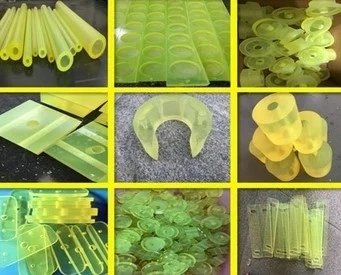
Another important advantage of polyurethane materials is their ability to maintain stable performance across a wide temperature range. Many polyurethane elastomers can operate effectively in both low and moderately high temperature environments without significant loss of mechanical strength or elasticity. This temperature resistance expands their applicability in industries where thermal fluctuations are common.
Polyurethane cast parts also demonstrate strong resistance to contamination, corrosion, and mechanical damage. Unlike certain metals that may corrode in humid or chemically aggressive environments, polyurethane materials generally exhibit good chemical stability. They resist oils, solvents, and many industrial chemicals, which makes them suitable for use in machinery, processing equipment, and transport systems. Additionally, polyurethane components are less prone to surface degradation when exposed to dust, moisture, or other environmental contaminants.