

The two major families of polyether polyols are polytetramethylene ether glycols (PTMEG) and polypropylene glycols (PPG). PTMEG is the premier polyol used in high-performance polyurethane elastomers. PTMEG-based polyurethanes exhibit superior resistance to hydrolytic cleavage, good mechanical property retention at low temperature, high resiliency, good processing characteristics, and excellent mechanical and dynamic properties. Strain-induced crystallization of the PTMEG soft segments, exact di-functionality, and low acid values are all contributing factors to the good mechanical properties of the associated polyurethane elastomers. PPG polyols have excellent hydrolysis resistance and low temperature properties as well. However, when compared to PTMEG polyols, the PPG polyols have lower mechanical properties and are more prone to thermo-oxidative degradation.
Balancing Polyurethane Elastomer Performance with Blends of PTMEG and PPG Polyols
Blending of PTMEG and PPG polyols can allow optimizing of properties and costs in polyether based polyurethane formulations. These polyol blends can create value in application such as PUR adhesives, cast polyurethane elastomers, thermoplastic polyurethanes and polyurethane dispersion coatings. Performance enhancements achieved by incorporating PTMEG into PPG polyols include tensile, tear and rebound properties, enhanced dynamic performance under cyclic loading, and more favorable tack-adhesion-cohesion balances. The lower cost PPG polyols can improve tack, "cold-hardening" characteristics and softness in PTMEG elastomers while balancing cost-performance profiles. PTMEG and PPG polyols are not co-miscible, so polyurethane elastomers will lack clarity.
To begin to understand the science behind achieving performance optimizations, it is valuable to look at the science underlying the differences between the PTMEG polyols and the PPG polyols.
PTMEG Polyols vs. PPG Polyols
Both PTMEG and PPG polyols are polyethers, which impart good low temperature properties and excellent hydrolytic stability to polyurethane elastomers. Both polyether classes exhibit very low Tg's in the soft segment of polyurethanes. The Tg of PTMEG polyol (Tg ~ 75°C) is lower than that of PPG polyols (~65°C). In addition, PTMEG has a uniform linear structure, which allows it to tightly pack in a PUR soft segment and undergo stress-induced crystallization. Stress crystallization results in a significant increase in the tensile properties, with a reduction in the ultimate elongation. PPG polyols are more complex structures with pendant methyl group that disrupt chain packing and afford non-crystallizable amorphous soft segment structures. As a result, PPG polyols in a PUR elastomer do not "cold harden", a beneficial feature.
The basic chemical structures and the synthetic routes to both polyether polyols are shown below.
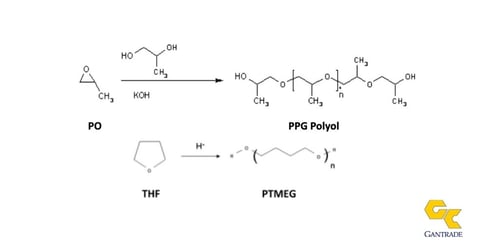
The table below compares the key characteristics and properties of PTMEG and PPG polyols.
| PTMEG | PPG Polyols | Comments | |
| Backbone Structure | Linear Aliphatic Polyether | Branched Aliphatic Polyether | Linear structures enhance van der Waals intermolecular forces |
| Crystallization Characteristics | Crystallizable | Does not crystallize | Stress crystallization affords performance enhancements |
| Hydroxyl End-Group | 100% primary -OH | Secondary -OH. 3-4% unsaturated chain ends | < 100% -OH chain ends reduce network formation, a negative |
| MWD:MW/MN | Moderate: 1.8-2.1 | Narrow: 1.02-1.08 | MWD influences properties and viscosity |
| PUR Mechanical Properties | Excellent | Good | PTMEG affords high tensile, resiliency and abrasion properties |
| Prepolymer Viscosities | Medium | Low | Low viscosities facilitate handling and processing |
The information in the above table provides useful guidance for formulating polyol blends to optimize specific performance features in a PUR elastomer.