Principles of Structure-Property Relationships
The linear structure of PTMEG promotes greater net van der Waals intermolecular interactions within the soft segment of PURs, thereby increasing mechanical and cohesive properties of the elastomer. Van der Waals forces are molecular-distance dependent and greater in structures that closely pack. The pendant methyl group in the PPG repeat unit sterically interferes with molecular packing and the van der Waals forces of attraction are thereby weakened. Blending of the PTMEG and PPG polyols in a PUR will alter the extent of the van der Waals interactions and allow a fine-tuning of properties like stress-induced crystallization, hard block phase separation, tack and adhesive properties, and cut and tear properties, etc. Some of these effects will be described later. Elongation induced crystallization is generally accepted to occur as the soft segment chains orient in the direction of the elongation.
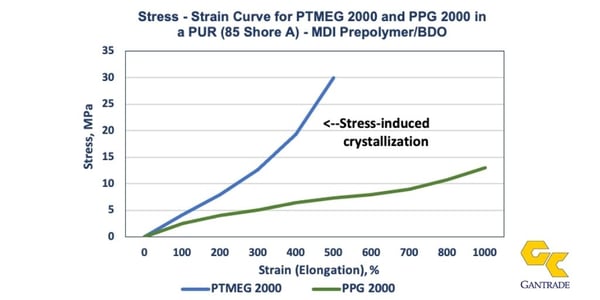
Increasing the percentages of PPG polyol in a blend with PTMEG suppresses the crystallization tendencies in the soft segment and reduces the cold and stress-induced crystallization behavior associated with the PTMEG component. Some indications of stress-induced crystallization continued to be detected even at a level of only 50% PTMEG in the soft segment. Studies observing the soft segment Tg's of blends of PTMEG and PPG polyols also suggest there is miscibility between the two polyols in a polyurethane elastomer. 1
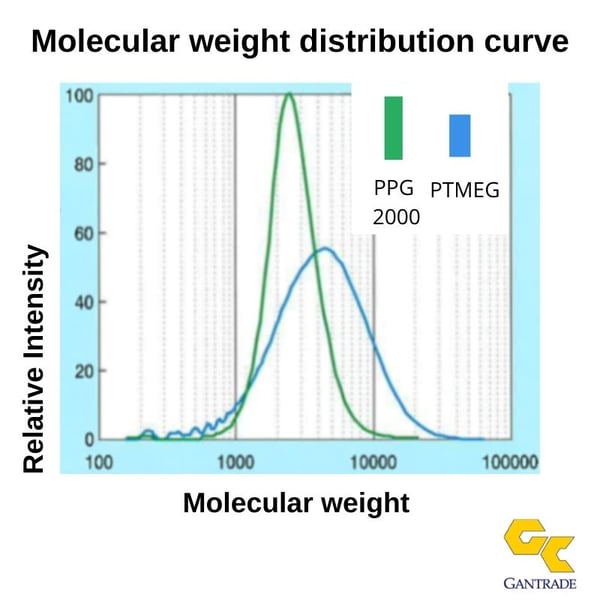
Another key property difference between the PTMEG polyols and PPG polyols is their molecular weight distributions (MWDs), MW/MN, as shown in the figure below. PTMEG polyols have a broader MWD vs. the PPG polyols which are characterized by very narrow MWD. Polyol MWD can have a significant effect on the handling, mechanical and dynamic properties in a PUR elastomer.