

Polyurethane isostatic pressing molds have increasingly become the preferred choice for high-performance molding applications across various industries, offering significant advantages over traditional rubber isostatic pressing molds. These advantages are particularly evident in areas such as application range, precision, deformation resistance, durability, surface finish, and ease of demolding.

1. Wider Application Range
One of the key advantages of polyurethane isostatic pressing molds is their broad hardness range, which allows them to be tailored to specific equipment or pressing processes. For instance, when pressing large-size components, high-hardness polyurethane molds provide excellent rigidity and support during loading, ensuring the mold does not deform under pressure. Conversely, for irregular or complex shapes, lower-hardness polyurethane molds act as soft molds, facilitating easy demolding after pressing. These versatile properties make polyurethane molds superior to conventional rubber molds, which cannot satisfy such diverse requirements.
2. Higher Precision
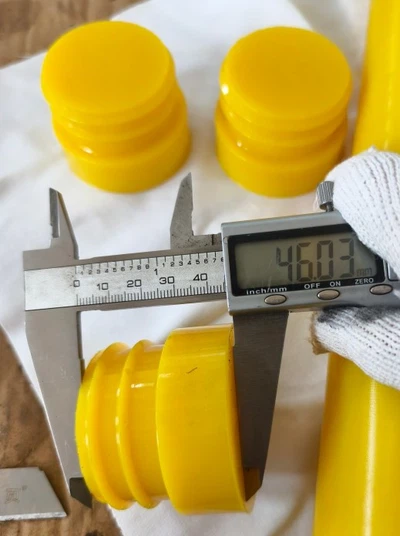
Polyurethane isostatic pressing molds are typically produced by casting, resulting in uniform material distribution and higher dimensional accuracy. This uniformity ensures consistent pressure distribution during the pressing process, which is especially critical when producing high-precision components. As a result, finished products retain accurate dimensions and high surface quality, offering a clear advantage over rubber molds.
3. Minimal Deformation and Higher Yield
Because polyurethane isostatic pressing molds are cast from liquid polyurethane prepolymer, the resulting mold exhibits superior material uniformity. During the pressing process, the applied pressure is evenly distributed, minimizing the risk of bending, twisting, or other deformations. This uniform pressure distribution significantly improves production yield and reduces the likelihood of defective parts.
4. Longer Service Life
Durability is another area where polyurethane isostatic pressing molds outperform rubber molds. Polyurethane has excellent compressive resistance, fast rebound, and minimal deformation, ensuring that the mold maintains its precision over long-term use. In contrast, rubber molds are prone to surface oxidation and stickiness after prolonged use. The inherent antioxidant properties of polyurethane prevent such degradation, guaranteeing consistent performance even after extended storage or repeated pressing cycles.
5. Smoother Surface Finish
The surface of polyurethane isostatic pressing molds is inherently smooth, allowing the pressed products to have a fine surface finish. This reduces the need for additional post-processing, thereby improving manufacturing efficiency and reducing overall production costs.

6. Easy Demolding
Polyurethane's excellent elasticity and low adhesion to materials make polyurethane isostatic pressing molds easy to demold. After pressing, components can be removed quickly without sticking, further reducing post-processing time and enhancing production efficiency.
Chengdu Yingdeshi Technology focuses on the research, development, and production of high-performance polyurethane isostatic pressing molds. Through close collaboration with isostatic equipment manufacturers and in-depth industry research, the company has developed a series of molds with long service life, high precision, minimal deformation, and easy demolding. These molds are widely applied in pressing ceramics, cemented carbides, rare-earth permanent magnets, graphite, and other high-precision industrial components.