


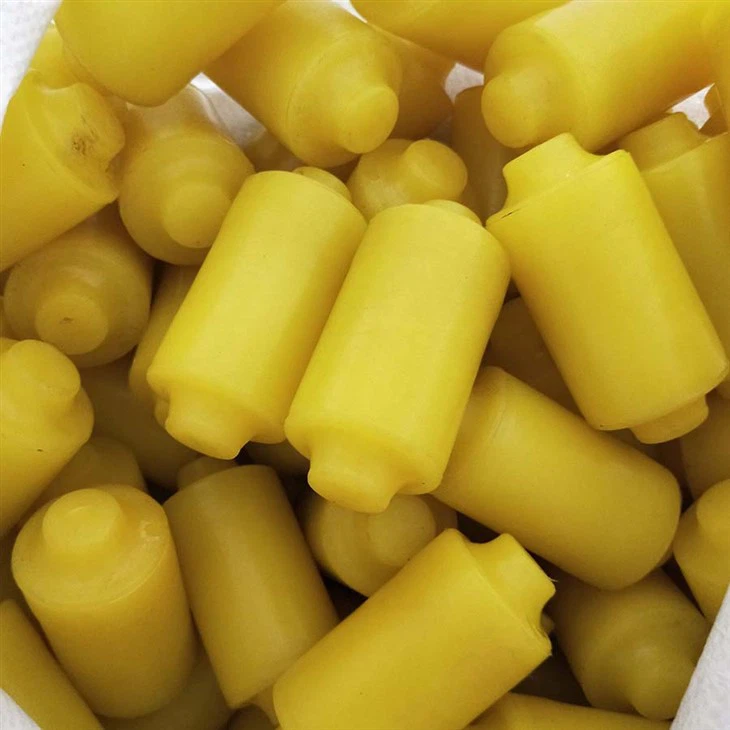

The low free TDI and polyester prepolymer is based on TDI and polyester polyols, with an extremely low content of free monomers (typically less than 0.1%). It can result in a non-toxic polyurethane system and reduce hazards during the processing. By using the same processing equipment, the morphology of the soft and hard segments can be easily controlled and the phase separation can be enhanced, thereby making the elastomer have better wear resistance, impact resistance and hydrolytic resistance.
The low free TDI monomer content in the low free TDI and polyester prepolymer is less than 0.1%, significantly enhancing operational safety. The series of pre-polymer has a lower viscosity, longer service life in the reactor, faster demolding speed, and significantly improving production efficiency.
Advantages of Low Free TDI Polyurethane Prepolymer
TDI refers to toluene diisocyanate. Conventional prepolymers contain high residual free TDI, while low-free-TDI products generally have free TDI content below 0.1% or even lower. Their advantages fall into four categories: environmental safety, product performance, construction & application, and storage & compatibility.
Core Advantages of Environmental Protection & Safety
1. Low toxicity and low irritation, greatly reduced occupational hazards
Free TDI is highly volatile and irritates the respiratory tract, skin and eyes. Long-term exposure may trigger allergic asthma and dermatitis. Low-free-TDI formulations release minimal volatiles with faint workshop odors, drastically lowering the risk of occupational diseases among workers.
2. Compliance with stringent environmental regulations
It meets national standards, EU REACH, VOC limits for interior coatings and adhesives, furniture adhesives, floor coatings, automotive interior materials and other mandatory specifications. Conventional high-free-TDI products fail environmental testing for indoor use and export shipments.
3. Reduced air pollution, no irritating fumes
No massive TDI vapor is released during high-temperature construction or baking, eliminating the need for high-load workshop ventilation and cutting waste gas treatment costs.
4. No harmful substance precipitation from finished products
When processed into adhesives, coatings or sealants, the final articles will not slowly release TDI during long-term service, making them suitable for children's furniture, food-contact packaging and indoor decoration scenarios.
2. Improved Physical & Chemical Properties of Finished Products
1. Uniform crosslinking and stable mechanical properties
Free TDI is a small molecule that tends to form brittle local segments via independent reactions. Prepolymers feature regular macromolecular chain segments. After curing:
- Higher tensile strength, tear strength and adhesion
- Better elasticity and toughness with less cracking
2. Enhanced weather resistance, hydrolysis resistance and anti-aging performance
Residual small-molecule TDI forms hydrophilic urea linkages after curing, leading to yellowing and cracking under long-term water exposure or sunlight. Low-free formulations contain fewer small-molecule impurities, delivering lower yellowing tendency and longer outdoor service life.
3. Lower volume shrinkage
Small-molecule TDI causes severe volume shrinkage upon curing, resulting in debonding and gaps. Low-free-TDI prepolymers feature low curing shrinkage for superior bonding and sealing performance.
4. Wide adjustable hardness range
Free of interference from excess free isocyanate, they can be precisely formulated with polyols to tune hardness, featuring evenly distributed soft and hard segments.
3. Advantages in Storage, Compatibility & Downstream Adaptation
1. Better storage stability
Free TDI has extremely high reactivity and easily absorbs moisture to self-polymerize and agglomerate. Low-free-TDI products offer longer shelf life without turbidity or precipitation under low-temperature storage.
2. Compatible with waterborne systems and low-VOC matched resins
High-free-TDI prepolymers cannot pair with waterborne hydroxyl components and may undergo violent explosive polymerization. Low-free variants are compatible with waterborne, high-solid and solvent-free systems for high-end eco-friendly product lines.
3. Applicable to high-standard industries including food, medical and children's articles
Free TDI is a restricted toxic contact substance; low-free-TDI products can be used for furniture adhesives, shoe sole adhesives, electronic potting compounds, automotive interiors and medical auxiliary materials that require regulatory compliance.
4. Simplified formulation development for downstream manufacturers
No extra anti-blooming or anti-yellowing additives are required, streamlining formulas and cutting auxiliary material costs.
Properties
|
Physical Properties |
Unit |
Numerical |
|
NCO content |
% |
5.5±0.2 |
|
Viscosity At 90℃ |
cps |
750 |
|
Process Temperature |
℃ |
80 |
|
MOCA Pot Life, Minutes |
min |
8 |
|
Demold Temp/Time |
℃/min |
100/30 |
|
Post cure |
℃/hours |
100/15 |
|
Hardness |
shoreA |
95±2 |
|
Tensile strength |
MPa |
55 |
|
100%Modulus |
MPa |
14.7 |
|
300%Modulus |
MPa |
29.6 |
|
Elongation at break |
% |
440 |
|
Tear Strength |
kN/ cm |
135 |
|
Rebound |
% |
34 |
|
Compression set B(70℃,22 hours) |
% |
32 |
Storage
Store in a dry and cool place, shelf life of 6 months.
Packing in 200kg drum or 20kgs


Hot Tags: Low free TDI PU Prepolymer, China Low free TDI PU Prepolymer manufacturers, suppliers, factory, PPG polyurethane, Polyurethane Used for Skate Wheels, Prepolymer to Urethane Wheels, Polyurethane prepolymer to polyurethane seal, polyurethane prepolymer for chemical resistant applications, Quasi MDI ester systems


